Roof pitch explained: x/12, degrees and percent
What a 6/12 roof means, how to measure the pitch, how to convert it to degrees or percent, and how it turns a house footprint into the roof area you actually have to cover.
Last reviewed · Written and maintained by the MaterialBuyCalc editorial team
Short answer
Pitch is how far a roof rises for every 12 inches it runs horizontally: a 6/12 roof rises 6 inches per foot. The same slope is 26.57° or 50%, and it makes the roof surface 1.118 times larger than the footprint it covers.
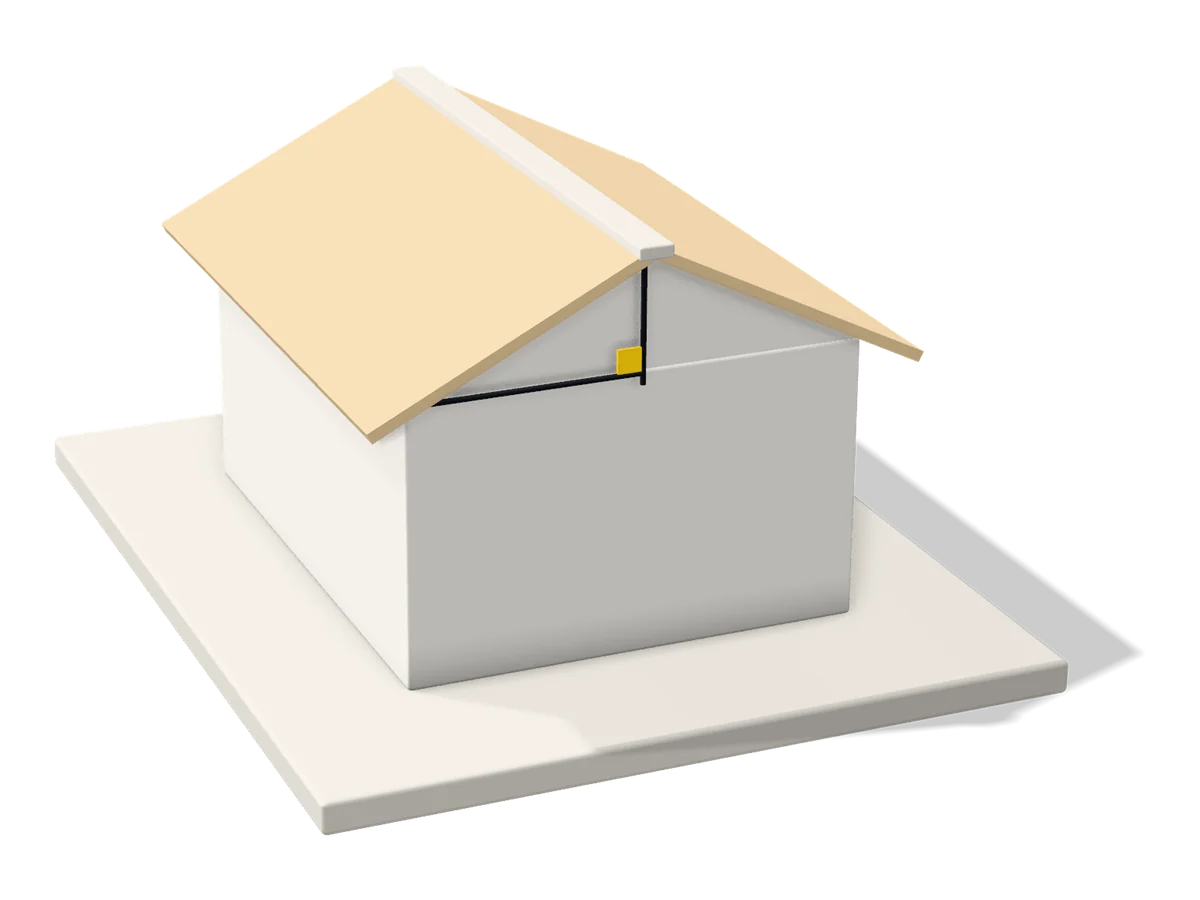
Three ways of writing the same slope
In the US, roofers give pitch as rise over a 12-inch run: 4/12, 6/12, 12/12. Plans and tools from elsewhere often use degrees, and many countries write roof slope as a percentage, which is the rise divided by the run, times 100.
They all describe the same triangle. A roof that rises 6 inches for every 12 inches across is 6/12, 26.57° and 50%. The table below lines the three up for the pitches you meet most often, together with the factor that converts a footprint into roof area.
| Pitch | Angle | Slope | Slope factor |
|---|---|---|---|
| 2/12 | 9.46° | 16.7% | 1.014 |
| 3/12 | 14.04° | 25% | 1.031 |
| 4/12 | 18.43° | 33.3% | 1.054 |
| 5/12 | 22.62° | 41.7% | 1.083 |
| 6/12 | 26.57° | 50% | 1.118 |
| 7/12 | 30.26° | 58.3% | 1.158 |
| 8/12 | 33.69° | 66.7% | 1.202 |
| 9/12 | 36.87° | 75% | 1.25 |
| 10/12 | 39.81° | 83.3% | 1.302 |
| 12/12 | 45° | 100% | 1.414 |
How to measure it
The safest place is the attic. Hold a level horizontally against the underside of a rafter, mark 12 inches along the level from the point where it touches, and measure straight up from that mark to the rafter. That distance is the rise per 12 inches. On the gable end of a shed or garage, the same measurement can be taken from a ladder against the edge of the roof.
A digital angle finder or a phone inclinometer gives degrees directly when laid on a rafter. Either way, avoid walking on a roof to take the measurement: the attic gives the same number.
The slope factor turns a footprint into roof area
A sloped roof has more surface than the ground it covers. The factor is √(1 + (rise ÷ run)²); for 6/12 that is √(1 + 0.25) = 1.118. Multiply the footprint, measured at the eaves so the overhang is included, by that factor to get the roof area.
A house with a 1,200 sq ft footprint under a 6/12 roof has 1,200 × 1.118 = 1,342 sq ft of roof, which is 13.4 roofing squares of 100 sq ft. The roofing calculator does this conversion and then adds waste and divides by your bundle coverage.
One pitch, any roof shape
The factor does not care about the shape of the roof, only about its slope. A gable, a hip roof or a pyramid roof whose planes all have the same pitch has a surface of footprint × slope factor. Hips and valleys change how the roof is cut, not how much surface it has.
When the planes have different pitches, such as a steep main roof and a shallow porch, measure each part's footprint separately and apply each pitch's factor to its own part.
Converting between them
Percent is rise ÷ run × 100. Degrees are the arctangent of rise ÷ run. To go back from degrees to x/12, multiply 12 by the tangent of the angle.
Two checks are worth remembering: 12/12 is exactly 45° and 100%, and 30° is 12 × 0.5774 = 6.93/12, a little under 7/12. The roof pitch calculator does all three conversions from any rise and run, in inches or centimetres.
Common questions
- Is a 100% slope a vertical wall?
- No. 100% means the rise equals the run, which is 45°, or 12/12. A vertical wall would be an infinite percentage.
- Should the overhang be in the footprint?
- Yes. The roofing covers the overhang too, so measure the footprint at the outer edge of the eaves, not at the walls.
- Why does pitch matter for the materials I buy?
- It changes the area, through the slope factor, and roofing products state the slopes they can be used on in their installation instructions. Check those for the product you choose.