How to work out the area of an irregular room or garden
Cut the outline into shapes you can measure, work each one out, add them and take away what you will not cover. Formulas for every common shape, a method for curves, and a way to check the total.
Last reviewed · Written and maintained by the MaterialBuyCalc editorial team
Short answer
Split the outline into rectangles, triangles, circles and trapezoids, work out each one and add them, then take away anything inside it that you will not cover, such as a pond or a fixed island. An L-shaped patio of 12 ft × 10 ft plus 6 ft × 5 ft is 120 + 30 = 150 sq ft.
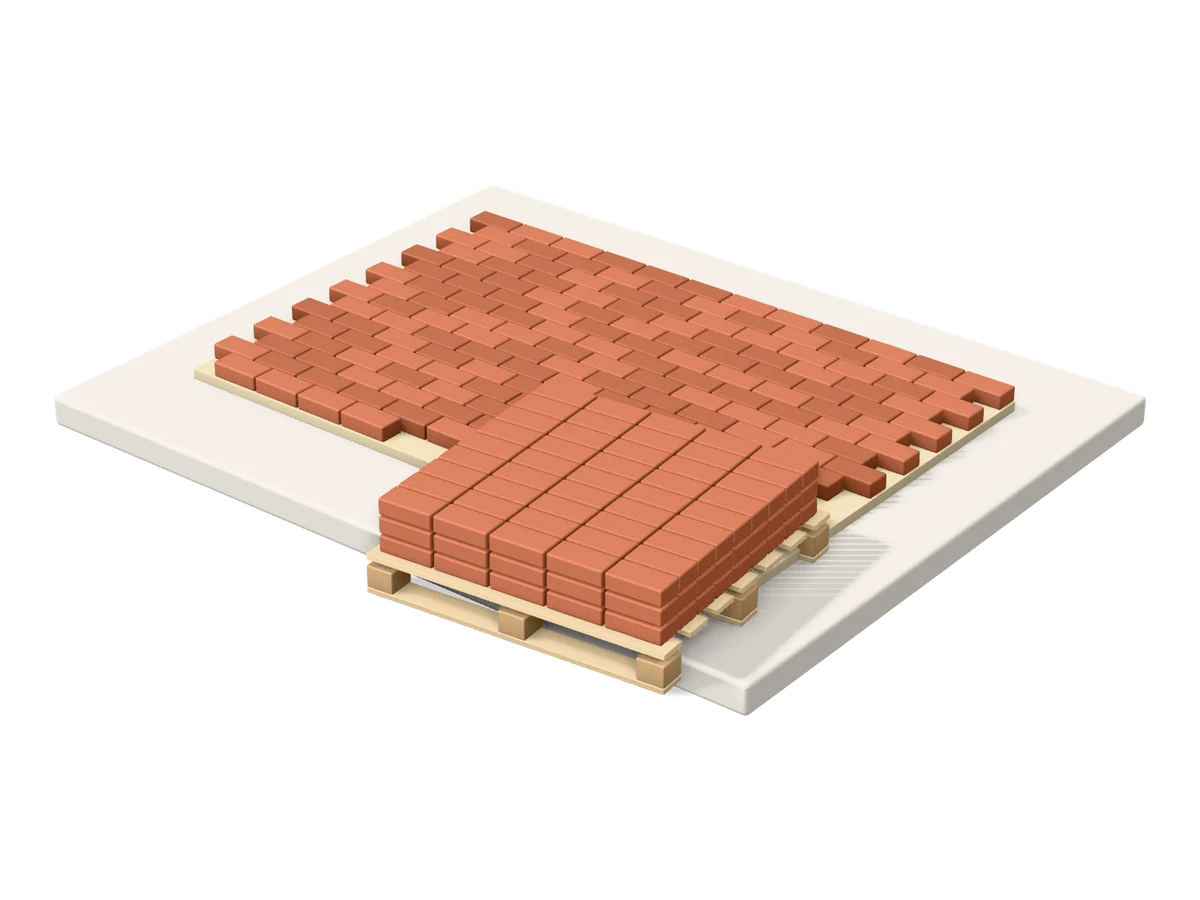
Draw it, then cut it into shapes
Make a rough sketch first, then draw straight lines across it until every piece is a rectangle, a triangle, a circle or part of one, or a trapezoid. Each of those has a simple formula, listed in the table below with a worked example.
Write each measurement on the sketch as you take it. If a total looks wrong later, the sketch shows which piece to measure again instead of starting from scratch.
| Shape | Measurements | Area |
|---|---|---|
| Rectangle: length × width | 12 ft × 10 ft | 120 ft² |
| Triangle: ½ × base × height | base 12 ft, height 9 ft | 54 ft² |
| Circle: π × radius² | diameter 10 ft | 78.54 ft² |
| Half circle: half of the circle | diameter 10 ft | 39.27 ft² |
| Trapezoid: average of the parallel sides × depth | parallel sides 12 ft and 8 ft, 5 ft apart | 50 ft² |
| L shape: two rectangles added | 12 ft × 10 ft plus 6 ft × 5 ft | 150 ft² |
Triangles without a right angle
Half of base × height only works when the height is measured square to the base, which is hard to do in a garden. If you can measure all three sides instead, Heron's formula does the rest: take half the perimeter, s, and the area is √(s × (s − a) × (s − b) × (s − c)).
For sides of 9, 12 and 15 ft, s is 18, and the area is √(18 × 9 × 6 × 3) = √2,916 = 54 sq ft. It matches half of 9 × 12, because this triangle happens to have a right angle, which makes it a good way to check the formula.
Curves: offsets from a straight line
For a curved bed or lawn edge, run a straight line along it and measure out to the curve at equal steps. Add up the inside measurements, add half of the two end ones, and multiply by the step.
Along an 18 ft line, measuring every 3 ft, offsets of 0, 4, 6, 6.5, 6, 4 and 0 ft give 3 × (4 + 6 + 6.5 + 6 + 4) = 79.5 sq ft. Smaller steps follow the curve more closely.
Take away what you will not cover
Measure what sits inside the outline and stays: a pond, a tree surround, a kitchen island, a fireplace hearth. Work out each of those the same way and subtract it from the total.
The area calculator on this site takes each piece as a separate line, marks the ones to subtract, and shows the sum it did.
Check the total against a box around it
Draw the smallest rectangle that encloses the whole shape and work out its area. Your total must be smaller, and it should not be far smaller unless the shape has big bites taken out of it.
The L-shaped patio above, 150 sq ft, sits inside a 12 ft × 15 ft rectangle of 180 sq ft: plausible. If the total had come out above 180, one of the pieces would have been counted twice.
Common questions
- What if the corners are not square?
- Measure a diagonal and split the shape into two triangles, then use the three-sides formula for each. It works whatever the angles are.
- How precise do I need to be?
- To the nearest inch is plenty. The waste allowance absorbs small errors; it does not absorb a corner you forgot to measure.
- Can I pace it out?
- For a first rough idea, yes. For an order, measure: a pace can easily vary by several inches.